Finland: Court Orders Seizure of Russian Assets Following Naftogaz Petition

Finnish court orders the seizure of Russian assets in response to a request by the Ukrainian company Naftogaz, as part of enforcing a $5 billion arbitration award for losses in Crimea.

Share:

Comprehensive energy news coverage, updated nonstop

Annual subscription

8.25$/month*

*billed annually at 99$/year for the first year then 149,00$/year ​

Unlimited access • Archives included • Professional invoice

OTHER ACCESS OPTIONS

Monthly subscription

Unlimited access • Archives included

5.2$/month*
then 14.90$ per month thereafter

FREE ACCOUNT

3 articles offered per month

FREE

*Prices are excluding VAT, which may vary depending on your location or professional status

Since 2021: 35,000 articles • 150+ analyses per week

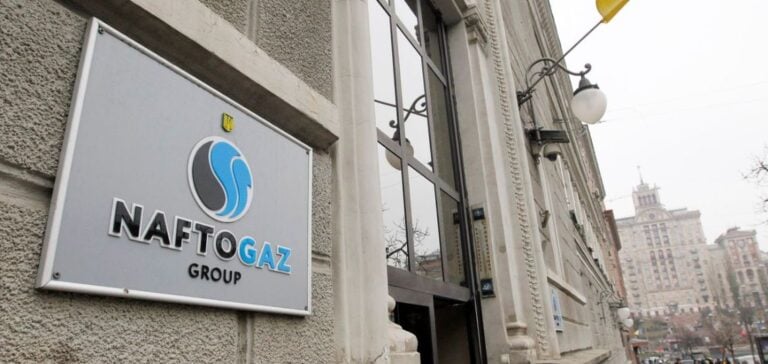
A Finnish court recently ordered the seizure of Russian assets valued at several tens of millions of dollars at the request of Naftogaz, Ukraine’s state-owned gas company. This decision marks a significant step in Naftogaz’s global strategy to seek compensation for the loss of its assets in Crimea in 2014, following the annexation of the peninsula by Russia.

The case dates back to April 2023, when an arbitration court in The Hague ordered Russia to pay Naftogaz $5 billion in compensation for damages caused by the seizure of its assets in Crimea. With Moscow having failed to comply with this ruling, Naftogaz has initiated legal proceedings in several countries, seeking to recognize and enforce this ruling on Russian assets located abroad.

First Asset Seizure Outside Ukraine

The Helsinki court’s decision marks a public first: this is the first successful seizure of Russian assets outside Ukraine to enforce an international court ruling related to the expropriation of Ukrainian property by Russia. According to Naftogaz, this ruling is part of a series of actions undertaken by the company to recover its confiscated property in Crimea. The company plans to intensify these efforts in other jurisdictions where Russian assets are located.

In a statement, Oleksiy Chernyshov, CEO of Naftogaz, welcomed this advance, calling it “a step closer to restoring justice.” He affirmed that the company would continue using “all available mechanisms” to recover the funds owed.

International Procedures for Arbitration Recognition

Prior to this decision in Finland, Naftogaz had obtained recognition of the arbitration in its favor in the United Kingdom in December 2022. In June 2023, the company also filed a petition with the District Court of Columbia in the United States to enforce The Hague’s ruling on Russian assets located in the U.S. These efforts reflect a desire to broaden the scope of arbitration enforcement in key jurisdictions, making it increasingly difficult for Russia to evade financial obligations.

Context of the Asset Seizure in Crimea

Naftogaz held various oil and gas assets in Crimea before Russia’s 2014 annexation, including gas storage facilities and drilling rigs valued at $400 million each. These assets also included the company ChornomorNaftoGaz, a gas producer, which produced 1.65 billion cubic meters (Bcm) of gas in 2013, with production expected to increase to 3 Bcm by 2015. Russia also seized around 2 Bcm of gas stored by Naftogaz in Crimea’s underground storage facilities.

Implications for Ukrainian Gas Production

The loss of Naftogaz’s assets in Crimea impacted Ukraine’s ability to produce natural gas, a challenge worsened by the ongoing military conflict since Russia’s invasion in 2022. Although national gas production fell to 18.5 Bcm in 2022, Naftogaz managed to increase output the following year to 18.7 Bcm and aims for a further increase to meet winter demand without resorting to costly European imports. Energy independence has become a priority for Kyiv, especially in light of high gas prices in Europe, where the Dutch TTF benchmark for the following month was 43.47 euros per megawatt-hour (MWh) on October 25.
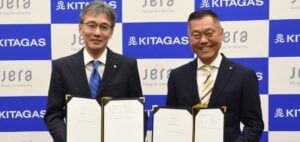

Japanese power producer JERA will deliver up to 200,000 tonnes of liquefied natural gas annually to Hokkaido Gas starting in 2027 under a newly signed long-term sale agreement.
An agreement announced on December 17, 2025 provides for twenty years of deliveries through 2040. The package amounts to 112 billion new Israeli shekels (Israeli shekels) (NIS), with flows intended to support Egyptian gas supply and Israeli public revenues.
Abu Dhabi’s national oil company has secured a landmark structured financing to accelerate the development of the Hail and Ghasha gas project, while maintaining strategic control over its infrastructure.
U.S.-based Sawgrass LNG & Power celebrates eight consecutive years of LNG exports to The Bahamas, reinforcing its position in regional energy trade.
Kinder Morgan restored the EPNG pipeline capacity at Lordsburg on December 13, ending a constraint that had driven Waha prices negative. The move highlights the Permian’s fragile balance, operating near the limits of its gas evacuation infrastructure.
ENGIE activates key projects in Belgium, including an 875 MW gas-fired plant in Flémalle and a battery storage system in Vilvoorde, to strengthen electricity supply security and grid flexibility.
Hungary has signed a contract with US company Chevron to import 400mn m³ of LNG per year, while maintaining a structural dependence on Russian gas through a long-term agreement with Gazprom.
Chevron Australia awards Subsea7 a major contract for subsea installation on the Gorgon Stage 3 project, with offshore operations scheduled for 2028 at 1,350 metres depth.
Ovintiv has entered into an agreement with Pembina Pipeline Corporation to secure 0.5 million tonnes per annum of LNG liquefaction capacity over 12 years, strengthening its export outlook to Asian markets.
TotalEnergies has completed the sale of a minority stake in a Malaysian offshore gas block to PTTEP, while retaining its operator role and a majority share.
The European Union will apply its methane emissions rules more flexibly to secure liquefied natural gas supplies from 2027.
Venezuela has ended all energy cooperation with Trinidad and Tobago after the seizure of an oil tanker carrying crude by the United States, accusing the archipelago of participating in the military operation in the Caribbean.
National Fuel has secured $350mn in a private placement of common stock with accredited investors to support the acquisition of CenterPoint’s regulated gas business in Ohio.
GTT appoints François Michel as CEO starting January 5, separating governance roles after strong revenue and profit growth in 2024.
The United States is requesting a derogation from EU methane rules, citing the Union’s energy security needs and the technical limits of its liquefied natural gas export model.
Falcon Oil & Gas and its partner Tamboran have completed stimulation of the SS2-1H horizontal well in the Beetaloo Sub-basin, a key step ahead of initial production tests expected in early 2026.
Gasunie Netherlands and Gasunie Germany have selected six industrial suppliers under a European tender to supply pipelines for future natural gas, hydrogen and CO₂ networks.
The ban on Russian liquefied natural gas requires a legal re-evaluation of LNG contracts, where force majeure, change-in-law and logistical restrictions are now major sources of disputes and contractual repricing.
The US House adopts a reform that weakens state veto power over gas pipeline projects by strengthening the federal role of FERC and accelerating environmental permitting.
Morocco plans to commission its first liquefied natural gas terminal in Nador by 2027, built around a floating unit designed to strengthen national import capacity.

All the latest energy news, all the time

Annual subscription

8.25$/month*

*billed annually at 99$/year for the first year then 149,00$/year ​

Unlimited access - Archives included - Pro invoice

Monthly subscription

Unlimited access • Archives included

5.2$/month*
then 14.90$ per month thereafter

*Prices shown are exclusive of VAT, which may vary according to your location or professional status.

Since 2021: 30,000 articles - +150 analyses/week.