Scatec and Fertiglobe sign 20-year hydrogen contract in Egypt

Scatec's Egyptian green hydrogen project, in partnership with Fertiglobe, reaches a key milestone with a 20-year sales contract for green ammonia, based on the H2Global program.

Share:

Hydrogène vert en Égypte

Comprehensive energy news coverage, updated nonstop

Annual subscription

8.25$/month*

*billed annually at 99$/year for the first year then 149,00$/year ​

Unlimited access • Archives included • Professional invoice

OTHER ACCESS OPTIONS

Monthly subscription

Unlimited access • Archives included

5.2$/month*
then 14.90$ per month thereafter

FREE ACCOUNT

3 articles offered per month

FREE

*Prices are excluding VAT, which may vary depending on your location or professional status

Since 2021: 35,000 articles • 150+ analyses per week

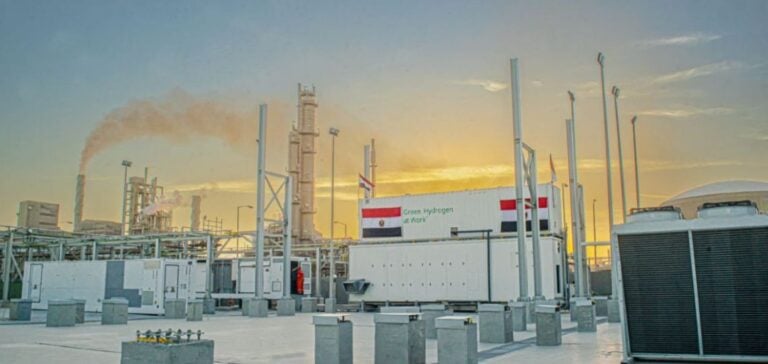
Scatec ASA and Fertiglobe have reached a major milestone in Egypt’s green hydrogen project. This project, developed in partnership with Orascom Construction, the Sovereign Fund of Egypt and the Egyptian Electricity Transmission Company, aims to produce renewable hydrogen to power the production of green ammonia. The sales agreement was signed at the Egypt-EU Investment Conference in Ain Sokhna.
The project is based on the installation of a 100 MW electrolyser powered by 270 MW of solar and wind energy. Scatec has also invested in wind power in Egypt. The aim is to produce around 13,000 tonnes of renewable hydrogen and up to 74,000 tonnes of green ammonia annually. This initiative demonstrates Egypt’s ability to position itself in the global green energy market, thanks to its renewable resources and strategic geographical location.

Partners and Funding

Scatec, as lead developer with a 52% majority stake, will provide EPC services in collaboration with Orascom Construction. The project is supported by the European Bank for Reconstruction and Development (EBRD), the European Investment Bank (EIB), DEG (KfW), British International Investment (BII) and the US International Development Finance Corporation (DFC).
Final financing of the project is scheduled for the first half of 2025, enabling Egypt to become a regional hub for green hydrogen. The project is located in the Suez Canal Economic Zone (SCZONE), which aspires to become a major center for the green hydrogen industry.

Key elements of the project

The 20-year sales agreement for green ammonia is the result of the first H2Global tender won by Fertiglobe. This agreement marks a significant step forward in the development of the project and paves the way for large-scale commercial production. Crucial next steps include selecting the electrolyser supplier and completing the project financing process with international financial partners.
The Egypt Green Hydrogen project aims to provide competitive and sustainable energy solutions, helping to diversify the Egyptian economy and attract foreign direct investment in the energy sector. This development is in line with Egypt’s strategy of becoming a leader in renewable energies and green hydrogen.

Economic and strategic impact

The development of green hydrogen in Egypt represents a strategic investment in the country’s energy infrastructure. It creates job opportunities and stimulates local economic growth. By partnering with international companies and financial institutions, Egypt is strengthening its position in the global green energy market and diversifying its sources of revenue.
The 20-year agreement for green ammonia guarantees stable, long-term demand for the hydrogen produced, providing financial security for the partners involved. In addition, collaboration with entities such as the EBRD, the EIB and other financial institutions reinforces the credibility of the project and ensures competitive financing.

Partner declarations

Ahmed El-Hoshy, CEO of Fertiglobe, underlined that this agreement is a crucial step for the sustainable production of ammonia and the future development of the green hydrogen project in Egypt. EIB Vice-President Gelsomina Vigliotti highlighted the important role of green hydrogen in the global energy transition.
Monika Beck, Managing Director of DEG, expressed DEG’s mission to promote green hydrogen as a driver of economic transformation. Iain Macaulay of the BII underlined Egypt’s potential to become a world leader in the production of renewable energy and green hydrogen.
This green hydrogen project represents a significant step forward for Egypt, positioning the country as a major player in the renewable energies sector. With the support of international partners and competitive financing, Egypt is on the way to becoming a global hub for green hydrogen, stimulating the energy transition and sustainable development.

The French government has issued an exclusive mining exploration permit to TBH2 Aquitaine to explore natural hydrogen in the Pyrénées-Atlantiques, bringing the young company’s total number of authorisations to two.
Hurricane Ventures, the investment fund affiliated with the University of Tulsa, has invested in Tobe Energy, a startup developing a membrane-free electrolysis system to produce low-cost clean hydrogen at industrial scale.
RWE has started commissioning a 100 MW electrolyser in Lingen, the first phase of a 300 MW project set to supply TotalEnergies’ refinery via a new hydrogen network under construction.
European Energy increases the capacity of its Måde Power-to-X site to 8.1 MW, with a new electrolyser in service and ongoing tests for commercial production in 2026.
Lhyfe aims to double its revenue next year, refocuses industrial priorities and plans a 30% cost reduction starting in 2026 to accelerate profitability.
Plug Power has completed the installation of a 5 MW PEM electrolyzer for Cleanergy Solutions Namibia, marking the launch of Africa’s first fully integrated green hydrogen production and distribution site.
Indian group AM Green has signed a memorandum of understanding with Japanese conglomerate Mitsui to co-finance a one million tonne per year integrated low-carbon aluminium production platform.
Next Hydrogen completes a $20.7mn private placement led by Smoothwater Capital, boosting its ability to commercialise alkaline electrolysers at scale and altering the company’s control structure.
Primary Hydrogen plans to launch its initial drilling programme at the Wicheeda North site upon receiving its permit in early 2026, while restructuring its internal exploration functions.
Gasunie and Thyssengas have signed an agreement to convert existing gas pipelines into hydrogen conduits between the Netherlands and Germany, facilitating integration of Dutch ports with German industrial regions.
The conditional power supply agreement for the Holmaneset project is extended to 2029, covering a ten-year electricity delivery period, as Fortescue continues feasibility studies.
HDF Energy partners with ABB to design a multi-megawatt hydrogen fuel cell system for vessel propulsion and auxiliary power, strengthening their position in the global maritime market.
SONATRACH continues its integration strategy into the green hydrogen market, with the support of European partners, through the Algeria to Europe Hydrogen Alliance (ALTEH2A) and the SoutH2 Corridor, aimed at supplying Europe with clean energy.
Operator GASCADE has converted 400 kilometres of gas pipelines into a strategic hydrogen corridor between the Baltic Sea and Saxony-Anhalt, now operational.
Lummus Technology and Advanced Ionics have started construction of a pilot unit in Pasadena to test a new high-efficiency electrolysis technology, marking a step toward large-scale green hydrogen production.
Nel ASA launches the industrial phase of its pressurised alkaline technology, with an initial 1 GW production capacity and EU support of up to EUR135mn ($146mn).
Peregrine Hydrogen and Tasmania Energy Metals have signed a letter of intent to install an innovative electrolysis technology at the future nickel processing site in Bell Bay, Tasmania.
Elemental Clean Fuels will develop a 10-megawatt green hydrogen production facility in Kamloops, in partnership with Sc.wén̓wen Economic Development and Kruger Kamloops Pulp L.P., to replace part of the natural gas used at the industrial site.
Driven by green hydrogen demand and state-backed industrial plans, the global electrolyser market could reach $42.4bn by 2034, according to the latest forecast by Future Market Insights.
Driven by mobility and alkaline electrolysis, the global green hydrogen market is projected to grow at a rate of 60 % annually, reaching $74.81bn in 2032 from $2.79bn in 2025.

All the latest energy news, all the time

Annual subscription

8.25$/month*

*billed annually at 99$/year for the first year then 149,00$/year ​

Unlimited access - Archives included - Pro invoice

Monthly subscription

Unlimited access • Archives included

5.2$/month*
then 14.90$ per month thereafter

*Prices shown are exclusive of VAT, which may vary according to your location or professional status.

Since 2021: 30,000 articles - +150 analyses/week.