The Libra consortium launches production at Mero-4 with a China-integrated FPSO
Production at the Mero-4 field began on May 24 using a 180,000 barrels/day FPSO, the result of international cooperation among six partners operating offshore Brazil.
| Sectors | Oil |
|---|---|
| Themes | Project Development, Industry & Execution, Operations & Maintenance |
| Companies | CNPC, CNOOC, Petrobras, TotalEnergies |
| Countries | Brazil, China |
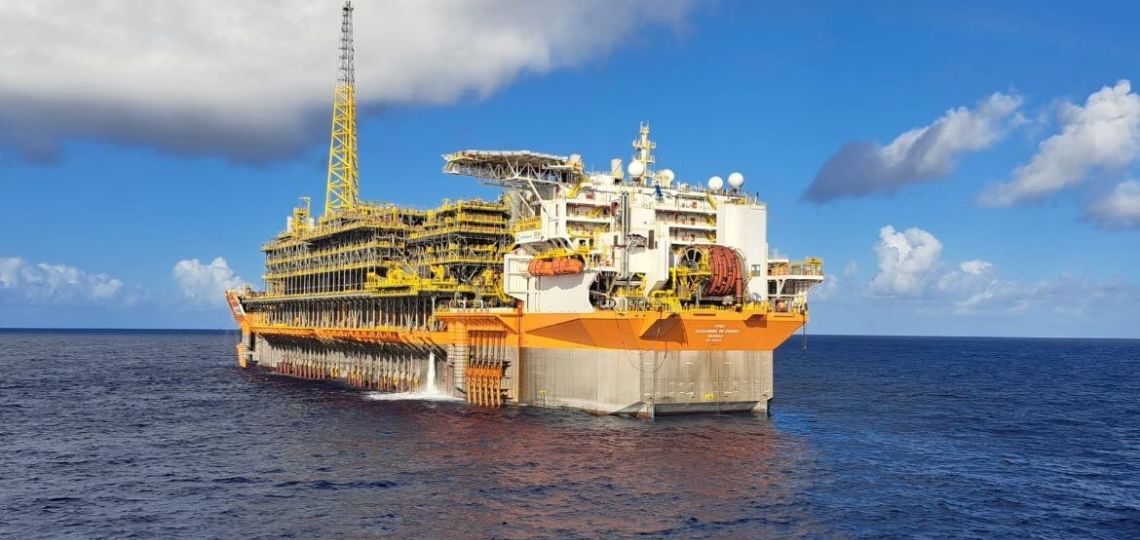
The international Libra consortium has started production at the Mero-4 oil field, located in the Santos pre-salt basin off the coast of Brazil. The announcement was made on May 26 by several members of the group, confirming the start-up of the FPSO (floating production, storage and offloading unit) Alexandre de Gusmão on May 24.
The infrastructure, positioned approximately 180 kilometres from Rio de Janeiro, operates at water depths ranging from 1,800 to 2,100 metres. The Mero-4 development includes 12 subsea wells — five oil producers, six alternating water/gas injectors, and one convertible well — all equipped with intelligent completion systems that enable remote switching between injection and production modes from the platform.
Floating unit designed for high volumes
The Alexandre de Gusmão FPSO, among the largest in the world by tonnage, was integrated in China in December 2024 before arriving on site in March 2025. It is rated for a daily processing capacity of 180,000 barrels of crude oil, compression of 12 million cubic metres of natural gas, and injection of 250,000 cubic metres of water. This brings the total installed production capacity at the Mero field to 770,000 barrels per day.
The project also incorporates HISEP (High Pressure Separator) technology, enabling subsea separation of oil and gas and re-injection of the gas into the reservoir. The objective is to maximise recovery while limiting surface flow rates.
Six-partner governance structure
The Mero field is operated under the Libra Production Sharing Contract (PSC), signed in December 2013. Petrobras holds 38.6% of the project as operator. Shell Brasil and TotalEnergies each hold 19.3%, while China National Petroleum Corporation (CNPC) and China National Offshore Oil Corporation (CNOOC) each own 9.65%. Pré-Sal Petróleo S.A. (PPSA) completes the consortium with 3.5%, representing the Brazilian federal government in the non-contracted area.