India accelerates its nuclear program to join the global top 5
With eleven reactors under construction and major projects such as Jaitapur, India is preparing a nuclear build-up that could place it among the world’s five leading nations in the sector.
| Sectors | Nuclear Energy, Fission |
|---|---|
| Themes | Industry & Execution, Innovation & Transformation, Corporate Strategy |
| Companies | NTPC, EDF, Rosatom |
| Countries | China, France, India, Russia, United States |
India currently operates 23 nuclear reactors with a total installed capacity of around 7.5 gigawatts (GW), representing a modest share of about 3% in its coal-dominated power mix. This limited base does not reflect the scale of New Delhi’s ambitions, as the country aims to make nuclear energy a pillar of its industrial and energy development. To achieve this, India has launched the construction of several new units and is multiplying technological partnerships.
Active construction across multiple strategic sites
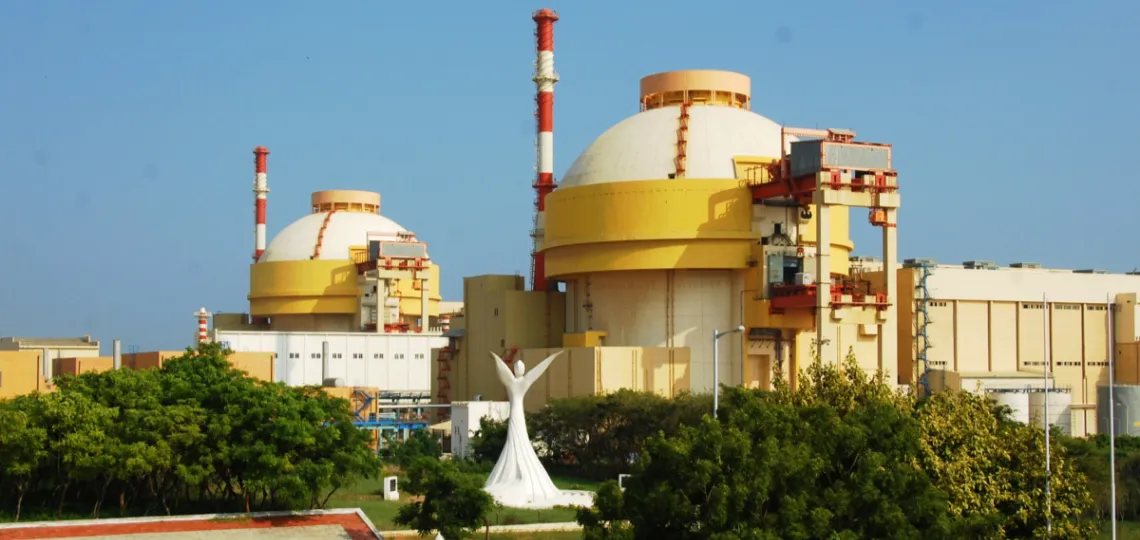
India’s fleet is expanding with between eight and eleven reactors under construction, representing an additional 6.6 to 8.7 GW. Among them, Kudankulam in Tamil Nadu stands out as the showcase of Indo-Russian cooperation. Units 3 to 6 there are based on Rosatom’s VVER-1000 technology. In Haryana, the Gorakhpur (GHAVP) project is planned to reach four 700-megawatt (MW) units, with two already underway. In Karnataka, the Kaiga 5 and 6 reactors, also 700 MW each, are intended to strengthen domestic supply. At Kalpakkam, the 500 MW Prototype Fast Breeder Reactor (PFBR), developed by the Indira Gandhi Centre for Atomic Research (IGCAR) and operated by Bharatiya Nabhikiya Vidyut Nigam Limited (BHAVINI), illustrates the country’s will to advance toward a sodium-cooled fast breeder line.
A scale-up coordinated by public players
The Nuclear Power Corporation of India Limited (NPCIL) remains the central operator and leads most projects underway. It now cooperates with National Thermal Power Corporation (NTPC) through the ASHVINI joint venture, which is notably developing the Mahi Banswara site in Rajasthan. This 2.8 GW project, based on four domestically designed reactors, marks a decisive step in the national strategy. These new builds fit into a broader trajectory aimed at doubling installed nuclear capacity within the next decade.
Critical international partnerships
India is not limiting its expansion to domestic partnerships. The Jaitapur project in Maharashtra is being developed with EDF and relies on six European Pressurized Reactors (EPR) of 1,730 MW each. While the timeline remains subject to administrative authorizations, this single project could add more than 10 GW of capacity and reposition the country in the global ranking. Russian involvement at Kudankulam and French prospects at Jaitapur highlight the international dimension of a program until now largely dominated by domestic engineering.
A reshuffle in the global hierarchy
With installed capacity expected to reach around 15 GW once ongoing projects are completed, India would overtake several countries but remain behind Japan and Russia. However, the commissioning of Jaitapur, combined with other planned projects, could raise total capacity above 25 GW in the 2030s. Such an increase would allow the country to surpass Japan and join the global top 5 alongside the United States, France, China, and Russia. This outlook underscores the strategic importance that New Delhi places on nuclear power to meet growing electricity demand and strengthen technological self-reliance.
A long-term industrial and strategic challenge
India’s roadmap also involves diversifying its players. Several private groups, including Tata Power and Reliance, are already positioning themselves on Small Modular Reactors (SMRs), anticipating a larger role for the private sector in nuclear power. Political discussions on easing participation rules reflect a desire to attract additional financing. In this context, nuclear energy appears as a strategic lever not only for the country’s energy security but also for its industry and international partnerships. The coming years will determine how fast India can turn this ambition into industrial reality and gain weight in the global sector hierarchy.