Azerbaijan restarts oil exploration with ExxonMobil, BP and MOL
Baku signs multiple deals with major industry players to boost exploration as oil reserves decline and ACG production slows.
| Sectors | Oil, Gas, Exploration & Production, Gas Exploration & Production |
|---|---|
| Themes | Investments & Transactions, Commercial Partnerships |
| Companies | BP, SOCAR, ExxonMobil, MOL |
| Countries | United Kingdom, Hungary, Türkiye, United States |
Azerbaijan has signed a series of oil and gas exploration agreements with several international companies, including ExxonMobil, BP, TPAO, MOL and Gran Tierra Energy, during the Baku Energy Week forum held from June 3 to 5. These partnerships follow the country’s first-ever bidding round launched in 2023, to which 11 companies responded out of the 23 invited.
The stated objective is to stimulate exploration activity as production at the Azeri-Chirag-Gunashli (ACG) field, Azerbaijan’s main oil asset, enters structural decline. Despite the commissioning in 2024 of a $6bn platform at ACG, authorities in Baku expect a gradual decrease in volumes of Azeri Light crude oil.
A new exploration framework
The State Oil Company of the Azerbaijan Republic (Socar) has launched a new dedicated subsidiary, Caspian Geophysical, equipped with advanced data processing capacity and airborne full-tensor gravity survey technology. According to company representatives, this is a first for the region.
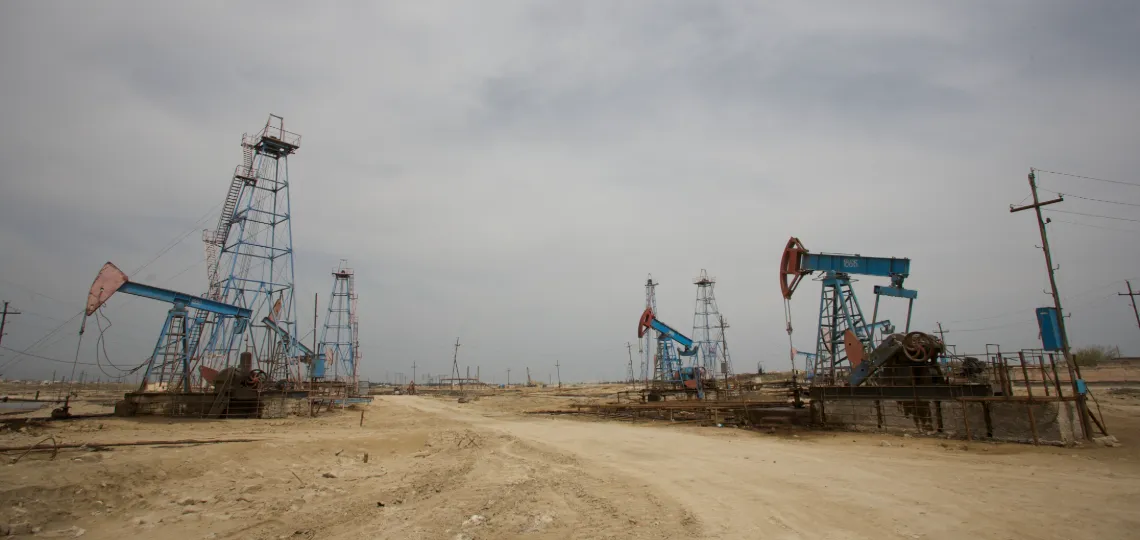
Efforts are focused on underexplored onshore areas. Socar currently produces 120,000 barrels per day (b/d) from its onshore and shallow-water operations. A memorandum of understanding has been signed with ExxonMobil to explore the Ganja-Yevlakh-Aghjabadi corridor in the country’s west-central region, applying shale oil techniques developed in the United States.
Rising interest in onshore resources
Gran Tierra Energy, active in Colombia and Ecuador, signed a memorandum for the Guba-Caspian region in northern Azerbaijan. MOL, already present in both the ACG field and the Baku-Tbilisi-Ceyhan pipeline, extended an existing agreement for exploration in the Shamakhi-Gobustan area. In parallel, independent GL Group launched Azerbaijan’s first horizontal onshore well in April, targeting the Kura basin.
Kamran Zahid, managing director of Caspian Geophysical, said no comprehensive seismic survey had been conducted in the onshore regions for over 20 years. The new geophysical data is expected to help identify previously overlooked structures.
Offshore deals and re-evaluation of potential
Offshore, BP signed an agreement with TPAO and Socar to appraise the Shafag-Asiman gas discovery, located over 7,200 metres below the seabed. Additionally, BP joined the Ashrafi-Dan Ulduzu-Aypara production sharing contract to explore Miocene geological formations.
BP is also conducting a five-year ocean-bottom seismic programme at ACG worth $370mn to identify bypassed hydrocarbons. ACG output declined only 2% year-on-year in Q1 2025, reaching 331,000 b/d. BP regional president Gary Jones said further drilling and gas injection wells are planned to stabilise production.
The US Energy Information Administration estimates that Azerbaijan’s reserves stood at 7bn barrels of oil and 60 trillion cubic feet (Tcf) of gas as of January 2025.