

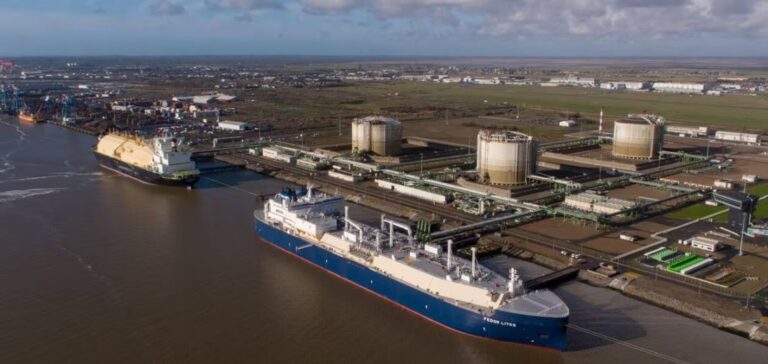
Europe: LNG investment booms despite stagnant demand

LNG regasification projects in Europe will increase capacity by 121 million tonnes/year by 2030. However, falling demand and utilization rates below 50% raise questions about the risk of overinvestment.

Share:

Baisse des prix du gaz

Comprehensive energy news coverage, updated nonstop

Annual subscription

8.25€/month*

*billed annually at 99€/year for the first year then 149,00€/year ​

Unlimited access • Archives included • Professional invoice

OTHER ACCESS OPTIONS

Monthly subscription

Unlimited access • Archives included

5.2€/month*
then 14.90€ per month thereafter

FREE ACCOUNT

3 articles offered per month

FREE

*Prices are excluding VAT, which may vary depending on your location or professional status

Since 2021: 35,000 articles • 150+ analyses per week

The diversification of energy sources in Europe, following Russia’s invasion of Ukraine in 2022, has led to strong interest in liquefied natural gas (LNG). Currently, 42 projects are planned between now and 2025, with 31 proposed and 11 under construction. These projects aim to ensure the region’s energy security, reducing dependence on Russian gas, which has fallen to 30 million m³/day.
Europe has seen a rapid increase in regasification capacity to alleviate LNG supply constraints, but current demand remains weak. According to data from S&P Global Commodity Insights, regasification facilities are operating at an average utilization rate of 46% in 2024, and have not exceeded 70% since April 2023.

Gas storage in Europe

Maximum gas storage capacity in Europe could lead to lower natural gas prices in the third quarter, despite a tight LNG market. Natural gas and LNG prices are expected to trend downwards as European Union (EU) gas storage capacities reach their maximum. However, this decline will be limited by the need to attract a sustainable volume of imports in a tight LNG market.
Since the beginning of 2023, Dutch TTF futures, the main reference for gas prices in Europe, have fluctuated significantly. After peaking in January, prices rose slightly in June before peaking on October 13, when European storage sites were 97.69% full, according to data from Gas Infrastructure Europe (GIE).
In 2024, prices continued to fluctuate between €22.9/MWh and €36/MWh. At the start of the second quarter, storage sites were 59.36% full. TTF futures prices then climbed 20.7% to €31.83/MWh on July 12, with sites 80.52% full.

Outlook for the Third Quarter

Analysts expect TTF prices to fall as storage capacity peaks before the end of October. However, this decline will be moderated by a tight LNG market, making the European gas system vulnerable to supply interruptions from Norway or the USA.
As of July 15, LNG imports into Europe stood at 79.66 billion cubic meters (Bcm), compared with 99.98 Bcm and 94.13 Bcm over the same periods in 2023 and 2022 respectively. This decline comes at a time when pipeline volumes have remained relatively cheap compared with LNG cargoes.

Impact of LNG imports and prices

Platts valued the DES North-West European marker price for August at $10.090/MMBtu as at July 12, a discount of 8.5 cents/MMBtu on the Dutch TTF gas hub price. LNG-TTF rebates in Europe averaged 32.5 cents/MMBtu this year, compared with $1.385/MMBtu and $3.849/MMBtu in 2023 and 2022 respectively.
These tighter discounts made pipeline supply more economical than LNG cargoes for the summer restocking season. However, with arbitrage conditions favoring Europe over Asia, US LNG volumes should increase in August and September.

Year-end outlook

With increased volumes of US LNG, stable pipeline flows and robust imports from Algeria, the European market should reach its maximum storage capacity earlier than last year. Despite this increased capacity, supply shocks could still affect the market.
Last year, LNG prices in North-West Europe fell from a winter peak of $16.877/MMBtu on October 23, 2023 to a low of $9.377/MMBtu on December 31. Prices continued to fall, reaching $8.251/MMBtu on March 31, before entering the European injection season.
The rapid development of regasification infrastructures in Europe could thus represent an insurance policy against future peaks in demand. However, current utilization rates, combined with a still timid demand, raise questions about the long-term profitability and efficiency of these massive investments.

The Canadian producer listed on the TSX Venture Exchange strengthens its leadership team with the appointment of Justin Post as Chief Operating Officer to accelerate the development of its gas storage project in New Zealand.
The consortium led by TotalEnergies secures exploration rights for Lebanon's offshore Block 8. This agreement, ratified on January 8, 2026, marks a milestone for a country facing unprecedented economic collapse.
The Turkish national oil company and the American major have formalized a memorandum of understanding in Istanbul. This partnership targets expansion of Black Sea operations, opening of new Mediterranean zones, and projects in Somalia.
The Intercontinental Exchange will align its European gas contracts and German power with Asian and American time zones. This extension to nearly 22 daily hours responds to the continental gas market's shift toward LNG.
Indian refiner Bharat Petroleum Corporation Limited seeks to secure its liquefied natural gas supplies with a long-term contract starting in 2026, indexed to multiple international price benchmarks.
The energy subsidiary of Sumitomo Corp is exploring the establishment of a liquefied natural gas trading operation in Singapore, following its London presence set up last August.
Tokyo denounces the presence of a Chinese drilling vessel in a disputed exclusive economic zone. This operation, reportedly targeting a gas field, reignites tensions between the two Asian powers.
The protocol signed between Egypt and Qatar outlines LNG exports to meet seasonal energy demand, as domestic gas production continues to decline.
Energy Transfer expects up to $17.7bn in consolidated EBITDA for 2026 and plans to invest up to $5.5bn, primarily focused on expanding its gas network in the United States.
Canadian company NG Energy finalises the sale of 40% of its stake in the Sinú-9 block to Maurel & Prom for $150mn, consolidating a joint venture on one of Colombia's largest gas fields.
Falcon Oil & Gas has secured shareholder approval to sell its majority stake in its Australian subsidiary to Tamboran group, clearing a key hurdle in a broader divestment transaction.
Quantum Capital Group sells nearly 90% of Cogentrix assets to Vistra for $4.7bn, marking a strategic repositioning of gas-fired assets in the United States.
Vital Energy has completed a strategic land acquisition in western Alberta, increasing its regional exposure to nine sections and supporting its development outlook in the Charlie Lake reservoir.
Eni and Repsol are facing difficulties recovering payments for gas deliveries to Venezuela, with an outstanding balance of $6bn and no clear engagement from U.S. authorities on the matter.
Chevron has launched production at the South N’dola field in Block 0 offshore Angola, leveraging existing infrastructure to support its investment strategy in offshore hydrocarbons.
The UK's $1.15bn funding withdrawal exposes the Mozambique LNG project to international political reversals, highlighting structural risks for large African energy projects reliant on foreign backers.
Osaka Gas has launched operations at the first unit of its new gas-fired power plant in Himeji, marking a key step in expanding its national electricity production capacity.
Technip Energies has received a key order linked to the Commonwealth LNG project in the United States, marking a decisive step ahead of the final investment decision expected in early 2026.
In response to rising domestic demand, Sonatrach adopts a five-year plan focused on increasing production, securing infrastructure, and maintaining export commitments.
Pipeline natural gas deliveries from Russia to the European Union dropped by 44% in 2025, reaching their lowest level in five decades following the end of transit via Ukraine.

All the latest energy news, all the time

Annual subscription

8.25€/month*

*billed annually at 99€/year for the first year then 149,00€/year ​

Unlimited access - Archives included - Pro invoice

Monthly subscription

Unlimited access • Archives included

5.2€/month*
then 14.90€ per month thereafter

*Prices shown are exclusive of VAT, which may vary according to your location or professional status.

Since 2021: 30,000 articles - +150 analyses/week.