Tehran threatens Bab el-Mandeb strait, a strategic corridor for oil
Iran has threatened to open a new front at the Bab el-Mandeb strait, a strategic passage linking Asia to Europe via the Red Sea, already weakened by Houthi attacks in 2024.
| Sectors | Oil, Transport & Storage |
|---|---|
| Themes | Policy & Geopolitics, Energy Security |
| Companies | Rystad Energy, ING Research |
| Countries | Yemen, Iran, Djibouti, Saudi Arabia, Eritrea |
Iran has threatened to open a "new front" at the Bab el-Mandeb strait in the event of an American ground invasion, according to an Iranian agency. The announcement comes as Tehran is already orchestrating a near-paralysis of the Strait of Hormuz, disrupting oil export routes from the Gulf. The economic repercussions of a Bab el-Mandeb blockage would be considerable, as the passage is one of the most heavily trafficked maritime corridors between Asia and Europe. These tensions reflect rising risks for oil transport, illustrated by the attack on a Turkish tanker carrying Russian oil in the Black Sea, and echo the US-Iran negotiations that have weighed on crude prices.
A corridor between the Red Sea and the Indian Ocean
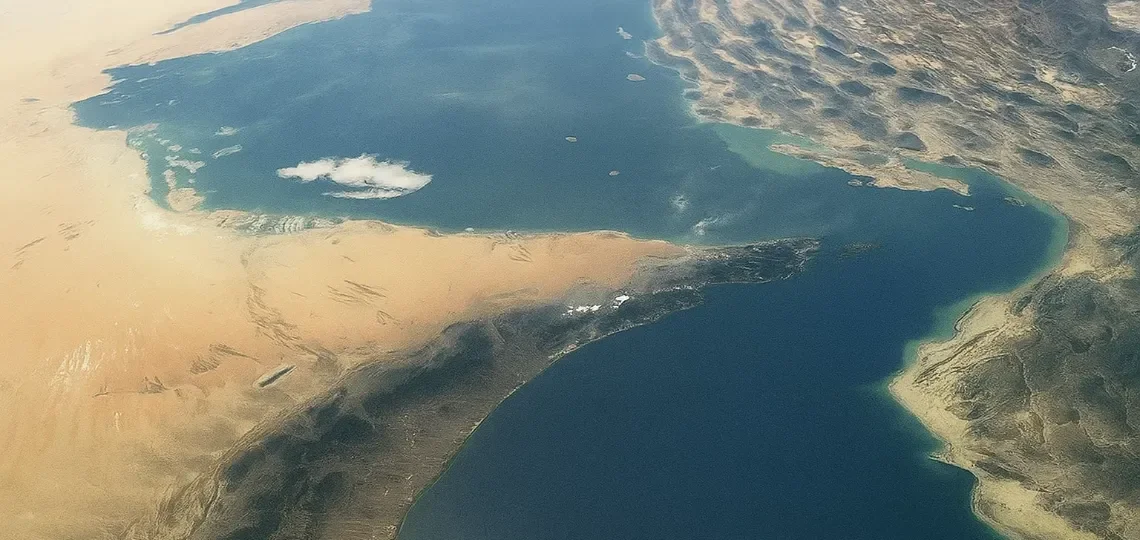
The Bab el-Mandeb is located at the southern tip of the Red Sea, where it connects to the Gulf of Aden in the Indian Ocean. Its name in Arabic means "the gate of tears". The strait separates Yemen, on the Arabian Peninsula, from Djibouti and Eritrea in Africa. It stretches roughly one hundred kilometres in length and some thirty kilometres in width, between the locality of Ras Menheli on the Yemeni coast and Ras Siyyan at Djibouti. The island of Perim, belonging to Yemen, divides the passage into two distinct maritime corridors.
Tankers and commercial vessels from the Indian Ocean transit this strait to reach the Red Sea and then the Suez Canal, before entering the Mediterranean. The only alternative is to circumnavigate Africa via the Cape of Good Hope, a considerably longer and more costly route. Since the start of the war in the Middle East, Bab el-Mandeb has become essential for connecting the port of Yanbu, in Saudi Arabia, the sole hub allowing the country to reroute part of the volumes blocked by the near-paralysis of Hormuz. Oil loadings at Yanbu have considerably increased, reaching "approximately 4 million barrels per day (...) an absolute record", according to Paola Rodriguez-Masiu, analyst at Rystad Energy.
Houthi attacks that have durably reduced traffic
Due to its geography, the strait is exposed to attacks by Houthi rebels from Yemen, who are close to Iran. In 2024, they targeted merchant vessels accused of ties with Israel, claiming solidarity with Palestinians. These actions triggered a lasting reduction in maritime transit through the zone. Even in the absence of recent incidents, "last week, traffic in terms of number of vessels represented only 55% of traffic for the same period in 2023", notes Rico Luman, transport economist at ING Research.
"The threat is obviously still present and the Houthis have already managed in the past to control the strait mainly from the coast, with limited means", adds Rico Luman. The persistence of this pressure maintains structural uncertainty for tanker operators and marine insurance markets.
One of the world's most militarised regions
The region encompassing the Suez Canal and the straits of Hormuz and Bab el-Mandeb is among the most militarised in the world. France's largest overseas military base is located in Djibouti, with some 1,500 troops. The United States has also positioned its only permanent base in Africa there, counting 4,000 soldiers. China opened its very first military base outside its territory in that same country in 2017, reflecting the strategic importance Beijing attaches to the zone. This international military density underscores the stakes that control of this passage represents for global energy supply.