First Light Fusion unveils a reactor pathway to a gain of 1,000
First Light Fusion presents FLARE, an inertial fusion concept targeting a gain of 1,000, with development costs said to be well below current benchmarks thanks to existing technologies and a deployment model based on partnerships.
| Sectors | Fusion Energy, Tokamak |
|---|---|
| Themes | Innovation & Transformation, Sector Innovation |
| Countries | United Kingdom, United States |
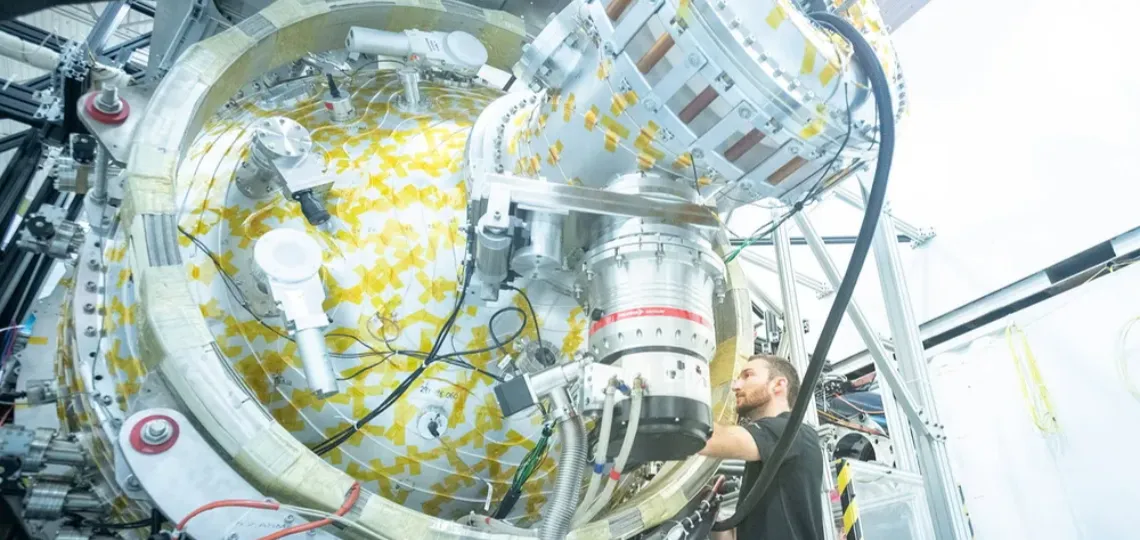
First Light Fusion details a reactor-compatible pathway targeting an energy gain of 1,000. The concept, named Fusion via Low-power Assembly and Rapid Excitation (FLARE), separates compression and ignition to maximise efficiency. The company outlines an industrial trajectory relying on available technologies and lower-power facilities. The stated objective is to reduce development and operating costs while reaching the economic thresholds required for electricity production from fusion.
Gain as the economic determinant
The gain measures the ratio between the energy produced and the energy injected into the fuel. The National Ignition Facility (NIF) holds a record gain of four. According to the company’s internal modelling, a gain of at least 200 would be necessary for commercial competitiveness. FLARE targets a gain of 1,000, a level presented as compatible with very low production costs.
First Light Fusion contends that a demonstration-scale gain facility would cost 20 times less than a device comparable to NIF. The company indicates that the energy and power needs of delivery systems would be significantly reduced. It assesses the cost of the energy delivery system at one tenth of previous fast ignition schemes. A lower pulse rate would reduce operating expenses and allow output to be adjusted for power grids.
Technical architecture and implementation
FLARE decouples fuel compression and ignition to leverage a fast ignition scheme. The company states that its controlled amplification technology makes this approach practicable. The use of lower-power systems already available is presented as a risk-reduction lever. This configuration would rely on standardised components and proven technologies.
First Light Fusion highlights potential acceleration of deployment through existing supply chains. The company expects partners could build the power systems using its technology as the target fuel. This model is described as suitable for rapid international rollout. Lower core-system complexity is cited as a factor in reducing committed capital.
Expert support and statements
The concept has received support from experts, including Jeremy Chittenden, Professor of Plasma Physics and Co-Director of the Centre for Inertial Fusion Studies at Imperial College London. Robert Trezona, partner at IP Group, cites an “asset-light business model” and a partnership path towards commercial viability. Lord David Willetts states that First Light Fusion “have now shown a credible pathway to viable commercial fusion”. Mark Thomas, Chief Executive Officer, states: “This is a pivotal moment not just for First Light, but for the future of energy”.