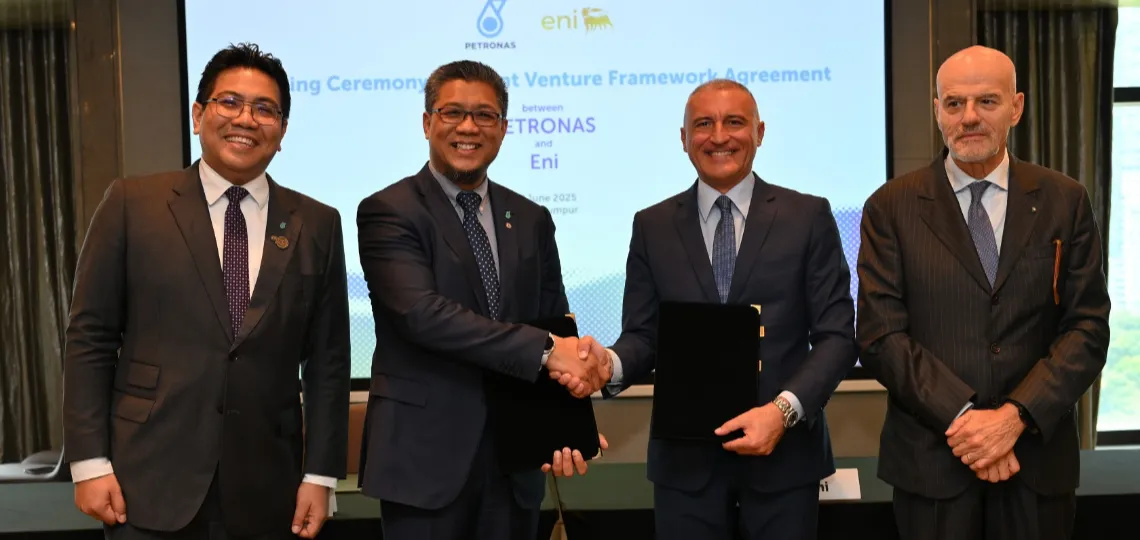
Eni and PETRONAS Create an ASEAN Upstream NewCo, $15B in Investments
The joint venture combines 19 assets (14 in Indonesia, 5 in Malaysia), aims for 300 kboe/d initially and >500 kboe/d, and focuses investments on gas to supply Bontang and the Malaysia LNG complex in Bintulu.
| Sectors | Gas, Natural Gas |
|---|---|
| Themes | Investments & Transactions, Project Finance |
| Companies | Eni, Petronas, SKK Migas |
| Countries | Indonesia, Italy, Malaysia |
The joint venture combines an upstream portfolio of nineteen interests with an initial production base exceeding 300,000 barrels of oil equivalent per day (boe/d) and a target beyond 500,000 boe/d. The announced investment plan exceeds $15 billion over five years, allocated to exploration, development drilling, subsea tiebacks, and optimizing existing infrastructure. The scope includes fourteen assets in Indonesia and five in Malaysia, enabling multi-asset campaigns and logistical synergies. The targeted resources combine discovered volumes estimated in billions of barrels of oil equivalent and additional exploration potential across the aggregated licenses.
Hub Mapping and LNG Integration
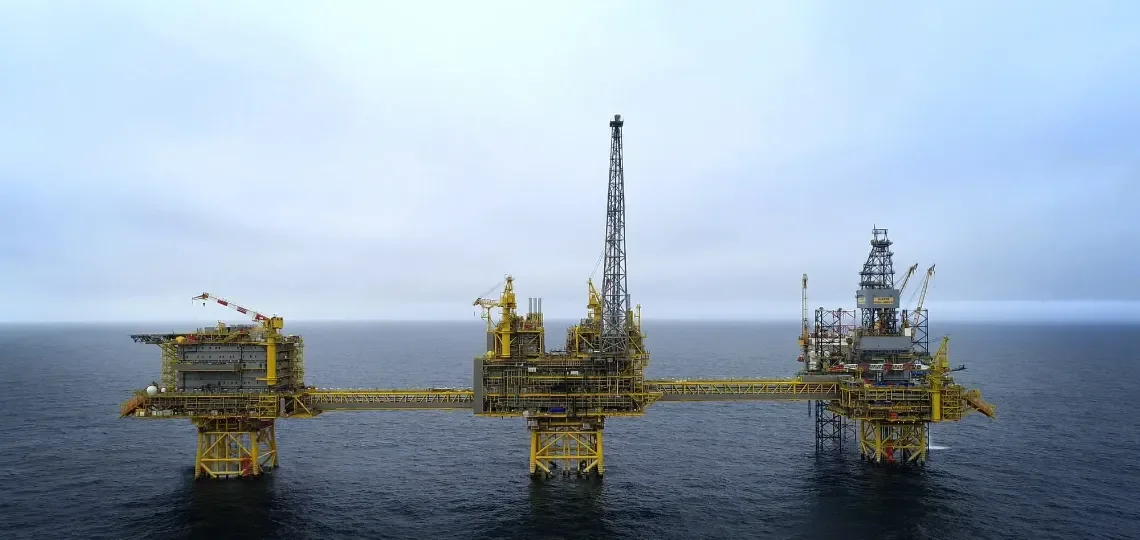
In Indonesia, the Kutei Basin is the priority axis with the “Northern Hub” combining Geng North and Gehem, and the development of Gendalo–Gandang for tiebacks to the floating production unit (FPU) and Bontang liquefaction plant. The start-up of Merakes East adds around 100 million standard cubic feet of gas per day and about 18,000 boe/d in incremental volumes, illustrating the strategy of small, quick additions. The Bontang plant has a nominal capacity of around 22.5 Mtpa, but operates primarily on four active trains with approximately 11.5 Mtpa, creating an immediate lever via the addition of “feed-gas.” In Malaysia, the Malaysia LNG complex in Bintulu totals around 29–30 Mtpa, with a modifiable capacity depending on maintenance and compression constraints.
Synergies aim to shorten time-to-market through subsea engineering standards and harmonized weather windows. Final investment decisions (FID) will be sequenced in clusters to smooth execution and coordinate pipeline–processing–liquefaction interconnections. The EPC (engineering, procurement, construction) chain is expected to benefit from multi-year visibility on wells, manifolds, compressors, and gas treatment modules. Arbitration will focus on throughput rates, recovery factors, and the order of field start-ups to optimize the use of liquefaction trains available.
Financial Governance, Contractual Framework, and Compliance
The NewCo is designed as a financially autonomous entity with ring-fencing of cash flows to facilitate financing backed by assets and contracts. Indonesian assets are governed by production sharing contracts (PSCs) and domestic market obligations (DMOs) that regulate domestic gas allocation and exports. In Malaysia, approvals are driven by Malaysia Petroleum Management on the upstream, with active partner consents required per asset. Local content requirements, taxation, and technical reporting impose robust governance documentation to ensure the conversion of approvals into deliverable volumes.
The business model targets an increasing share of equity gas allocated to long-term LNG contracts indexed to the Japan Korea Marker (JKM) and hybrid pricing structures. Regional buyers—primarily Japan, China, and Korea—favor deliveries with options for volume flexibility and windows, subject to train and fleet availability. The logistics coverage includes the availability of LNG carriers, berthing slots, and the insurability of routes, key variables during ramp-up phases. Payment terms, quality tolerance clauses, and price revision mechanisms represent contractual points of attention.
Execution Data and Industrial Constraints
Operational objectives include ramping production from >300 kboe/d to >500 kboe/d, primarily from gas, with increments coming from tiebacks and compression. Improving the utilization factor of existing plants results from a steady feed-gas input and smoothing planned downtime. Identified risks include well performance, pipeline integrity, compressor availability, and maintenance window synchronization. Mitigation measures rely on standardizing wellheads, providing redundancy for dynamic equipment, and contracting EPC with verifiable milestones.
On the financial flows, the backing of producing and upcoming assets creates a capital profile modulated by ramp-ups, with sensitivity to spot prices and JKM spreads. Capital circulation needs increase during the stacking of drilling and subsea campaigns; the ring-fenced structure facilitates access to dedicated lines. Performance indicators monitored include cost per well, first gas time, train availability, and capex/boe added ratio. The logistics and offshore contracts with charterers constitute immediate levers.
Operational Assumptions and Commercial Trajectory
The creation of the NewCo aims for accelerated execution by portfolio rather than by isolated concession, to reduce marginal costs and maximize the use of existing infrastructure. The commercial trajectory relies on a mix of long-term contracts and flexible volumes indexed to JKM, sized to capture seasonal Asian peaks. The gradual improvement in Bontang and Bintulu utilization depends on the availability of dry gas and compression–debottlenecking arbitrage. Expected economies of scale hinge on the pooling of rigs, the continuity of teams, and the coordinated planning of subsea interventions.
For the companies involved, the expected effects focus on increasing the gas share in the production mix, visibility on cash flows, and the creation of future options for refinancing at the NewCo level. For clients, the interest lies in more readable delivery windows and greater flexibility in contractual terms. For the states, the balance between domestic supply and LNG export remains the central variable for volume allocation. Actual performance will depend on the cadence of FIDs, adherence to schedules, and the stability of key technical parameters.