China Crosses 10,000 TWh Power Consumption Milestone and Accelerates Energy Transition
China’s electricity consumption reached 10,368 TWh in 2025, a global first. Non-fossil energy now accounts for over 60% of installed capacity, while thermal power output declines for the first time in ten years.
| Sectors | Solar Energy |
|---|---|
| Themes | Markets & Finance |
| Companies | Huawei |
| Countries | China |
China reached a historic milestone in 2025. Annual electricity consumption hit 10,368.2 TWh, up 5% year-on-year, according to the National Energy Administration (NEA). This volume exceeds the combined consumption of the European Union, Russia, India, and Japan, and represents more than double that of the United States, the agency said. Demand has doubled since 2015, when it stood at 5,000 TWh.
Services and Residential Drive Growth
The services sector and residential consumption accounted for 50% of total growth, according to the NEA. Services consumption rose 8.2% to reach 1,994.2 TWh, while residential demand increased 6.3% to 1,588.0 TWh. The secondary sector remains the largest consumer at 64% of total demand, posting a 3.7% increase to 6,636.6 TWh. The primary sector reached 149.4 TWh, up 9.9%.
Growth momentum is shifting from traditional heavy industries to advanced manufacturing sectors. In Jiangsu, annual consumption by computer, communications, and electronics industries exceeded 50 TWh for the first time, surpassing steel and chemicals. Strategic emerging industries in the province posted an 11.2% increase, outpacing overall manufacturing growth by 7.6 percentage points, according to State Grid Jiangsu data cited by the NEA. In Ningbo, Zhejiang province, electric vehicle manufacturing, aerospace, and advanced equipment sectors all recorded double-digit growth.
Electric Vehicles and Digital Economy
Electric vehicle charging and battery swapping surged 48.8% nationwide, while IT-related industries grew 17%. In Hangzhou, 5,011 charging stations were built in 2025, and electricity demand for these services increased by nearly 50%. The digital economy is also fueling regional growth. In Guizhou, internet data services consumption soared 95% year-on-year. The Huawei Cloud data center in Gui’an posted a 56.9% increase.
Yang Kun, Executive Vice Chairman of the China Electricity Council, noted that this pace of consumption growth is unprecedented among major economies. It would reflect China’s status as a manufacturing and population powerhouse, as well as the country’s enhanced energy security, according to his statements.
Historic Decline in Thermal Power
Alongside this record growth, thermal power generation, mostly coal-based with a small portion from natural gas, fell 1% in 2025 to 6.29 trillion kWh, according to the National Bureau of Statistics (NBS). This marks the first decline in ten years. December recorded a steeper drop of 3.2% year-on-year. NBS statistics cover industrial enterprises with annual revenue exceeding 20 million yuan ($2.87 million).
Hydropower output grew 2.8% for the full year and 4.1% in December, according to the NBS. Nuclear power posted 7.7% growth in 2025 and 3.1% in December. NBS data showed total power generation of 9.72 trillion kWh, up 2.2%, a figure lower than NEA data as it excludes some smaller-scale renewable generation, particularly solar.
Massive Expansion of Renewable Capacity
By the end of November 2025, installed wind and solar capacity reached 1,760 GW, up 34% year-on-year, according to the NEA. Non-fossil sources now account for over 60% of total installed capacity, becoming the dominant source of electricity. One in every three kWh consumed in China now comes from green sources, the administration said.
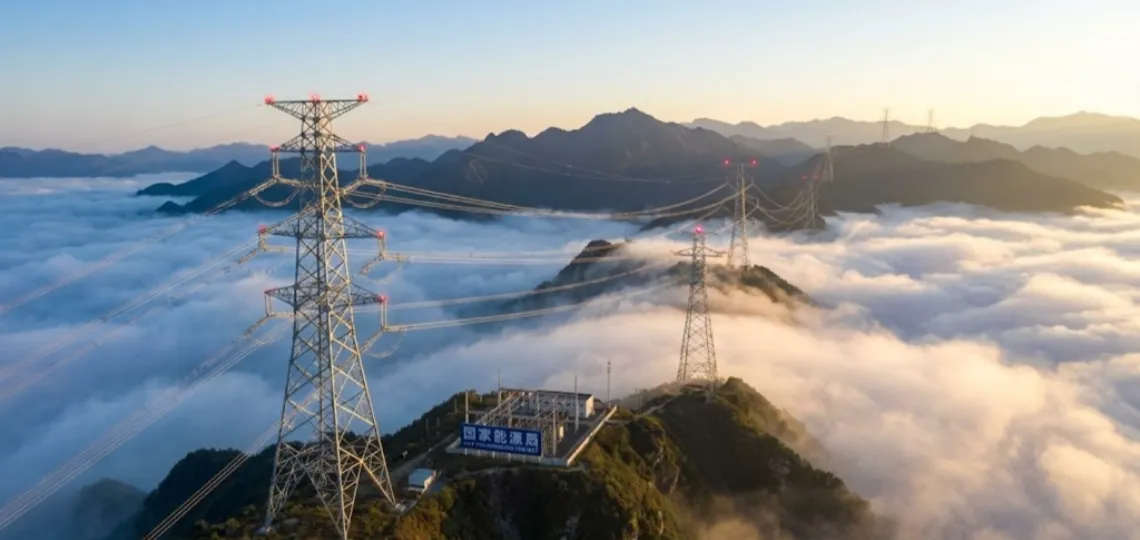
Four new ultra-high voltage transmission lines were put into operation in 2025, raising cross-provincial transmission capacity to 370 GW. The country now operates 46 ultra-high voltage lines, enhancing the delivery of clean energy from resource-rich western regions to high-demand eastern and southern provinces.
Energy Storage Acceleration
To address renewable intermittency, China has accelerated energy storage deployment. Pumped hydro storage capacity exceeded 66 GW by the end of 2025, with more than 80% of stations having capacity of 1 GW or above. New types of energy storage surpassed 100 GW, up more than 30-fold from the end of 2020, according to NEA data.
Thermal power generation is unlikely to accelerate in 2026 given the momentum of renewables. Feng Dongbin, Vice General Manager at Fenwei Digital Information Technology, operator of the Sxcoal analytics platform, said the trend toward a structural shift in power generation would be difficult to reverse. However, coal output reached a record high in 2025, illustrating persistent tensions between climate ambitions and Chinese industrial realities.