GASCADE commissions 400 kilometres of hydrogen network in Germany

Operator GASCADE has converted 400 kilometres of gas pipelines into a strategic hydrogen corridor between the Baltic Sea and Saxony-Anhalt, now operational.
Share:

Comprehensive energy news coverage, updated nonstop

Annual subscription

8.25$/month*

*billed annually at 99$/year for the first year then 149,00$/year ​

Unlimited access • Archives included • Professional invoice

OTHER ACCESS OPTIONS

Monthly subscription

Unlimited access • Archives included

5.2$/month*
then 14.90$ per month thereafter

FREE ACCOUNT

3 articles offered per month

FREE

*Prices are excluding VAT, which may vary depending on your location or professional status

Since 2021: 35,000 articles • 150+ analyses per week

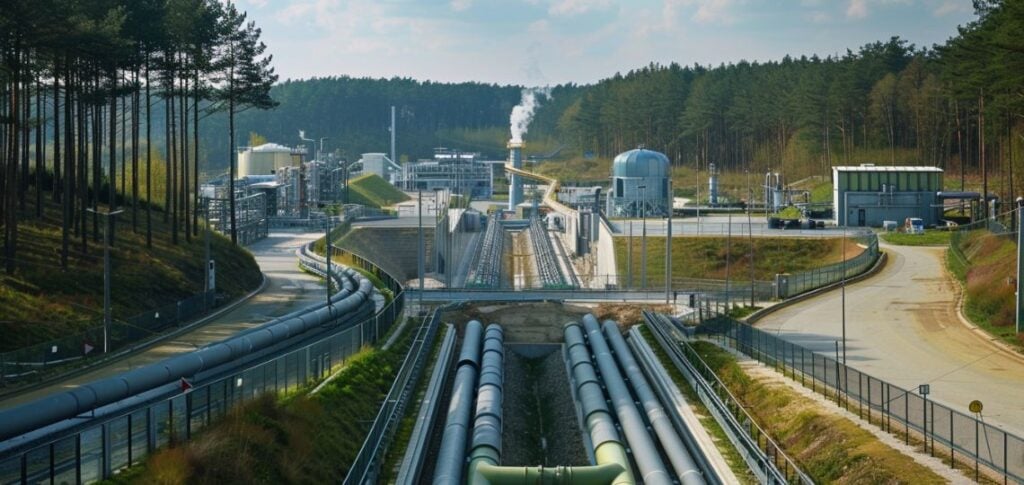
The company GASCADE Gastransport GmbH has announced the commissioning of a 400-kilometre section of its network, now dedicated to hydrogen transport. This conversion, carried out using former gas pipelines, is part of the Flow – making hydrogen happen programme, which aims to establish a key hydrogen corridor between northern and eastern Germany. The infrastructure forms a central segment of the German hydrogen core network and is immediately available to industrial users.
Technical transformation of existing infrastructure

The project is based on the conversion of natural gas infrastructure, with a diameter of 1.4 metres, to enable the safe transport of hydrogen. This approach reduces construction costs compared to new installations. The operation has allowed GASCADE to rapidly provide transport capacity along a strategic axis, facilitating access to an alternative energy source for German industry. The network extends from the Baltic Sea region to Saxony-Anhalt, at the heart of eastern industrial zones.

Access to imports and local production

The corridor is designed to receive hydrogen from multiple sources, including international imports via the port of Rostock and local production in northern Germany, particularly around the Lubmin site. The infrastructure already incorporates a European outlook, with planned connections to neighbouring countries. This positioning strengthens Germany’s role in developing the cross-border hydrogen market.

A foundation for industrial deployment

The company highlights that this operational network offers planning security for industrial stakeholders seeking to integrate hydrogen into their processes. By facilitating the availability of significant volumes, GASCADE aims to support the deployment of hydrogen in German industry. This project marks a step in the structuring of the national network, relying on existing resources to meet a growing demand for compatible infrastructure.

The French government has issued an exclusive mining exploration permit to TBH2 Aquitaine to explore natural hydrogen in the Pyrénées-Atlantiques, bringing the young company’s total number of authorisations to two.
Hurricane Ventures, the investment fund affiliated with the University of Tulsa, has invested in Tobe Energy, a startup developing a membrane-free electrolysis system to produce low-cost clean hydrogen at industrial scale.
RWE has started commissioning a 100 MW electrolyser in Lingen, the first phase of a 300 MW project set to supply TotalEnergies’ refinery via a new hydrogen network under construction.
European Energy increases the capacity of its Måde Power-to-X site to 8.1 MW, with a new electrolyser in service and ongoing tests for commercial production in 2026.
Lhyfe aims to double its revenue next year, refocuses industrial priorities and plans a 30% cost reduction starting in 2026 to accelerate profitability.
Plug Power has completed the installation of a 5 MW PEM electrolyzer for Cleanergy Solutions Namibia, marking the launch of Africa’s first fully integrated green hydrogen production and distribution site.
Indian group AM Green has signed a memorandum of understanding with Japanese conglomerate Mitsui to co-finance a one million tonne per year integrated low-carbon aluminium production platform.
Next Hydrogen completes a $20.7mn private placement led by Smoothwater Capital, boosting its ability to commercialise alkaline electrolysers at scale and altering the company’s control structure.
Primary Hydrogen plans to launch its initial drilling programme at the Wicheeda North site upon receiving its permit in early 2026, while restructuring its internal exploration functions.
Gasunie and Thyssengas have signed an agreement to convert existing gas pipelines into hydrogen conduits between the Netherlands and Germany, facilitating integration of Dutch ports with German industrial regions.
The conditional power supply agreement for the Holmaneset project is extended to 2029, covering a ten-year electricity delivery period, as Fortescue continues feasibility studies.
HDF Energy partners with ABB to design a multi-megawatt hydrogen fuel cell system for vessel propulsion and auxiliary power, strengthening their position in the global maritime market.
SONATRACH continues its integration strategy into the green hydrogen market, with the support of European partners, through the Algeria to Europe Hydrogen Alliance (ALTEH2A) and the SoutH2 Corridor, aimed at supplying Europe with clean energy.
Lummus Technology and Advanced Ionics have started construction of a pilot unit in Pasadena to test a new high-efficiency electrolysis technology, marking a step toward large-scale green hydrogen production.
Nel ASA launches the industrial phase of its pressurised alkaline technology, with an initial 1 GW production capacity and EU support of up to EUR135mn ($146mn).
Peregrine Hydrogen and Tasmania Energy Metals have signed a letter of intent to install an innovative electrolysis technology at the future nickel processing site in Bell Bay, Tasmania.
Elemental Clean Fuels will develop a 10-megawatt green hydrogen production facility in Kamloops, in partnership with Sc.wén̓wen Economic Development and Kruger Kamloops Pulp L.P., to replace part of the natural gas used at the industrial site.
Driven by green hydrogen demand and state-backed industrial plans, the global electrolyser market could reach $42.4bn by 2034, according to the latest forecast by Future Market Insights.
Driven by mobility and alkaline electrolysis, the global green hydrogen market is projected to grow at a rate of 60 % annually, reaching $74.81bn in 2032 from $2.79bn in 2025.
Plug Power will supply a 5MW PEM electrolyser to Hy2gen’s Sunrhyse project in Signes, marking a key step in expanding RFNBO-certified hydrogen in southern France.

All the latest energy news, all the time

Annual subscription

8.25$/month*

*billed annually at 99$/year for the first year then 149,00$/year ​

Unlimited access - Archives included - Pro invoice

Monthly subscription

Unlimited access • Archives included

5.2$/month*
then 14.90$ per month thereafter

*Prices shown are exclusive of VAT, which may vary according to your location or professional status.

Since 2021: 30,000 articles - +150 analyses/week.